Results
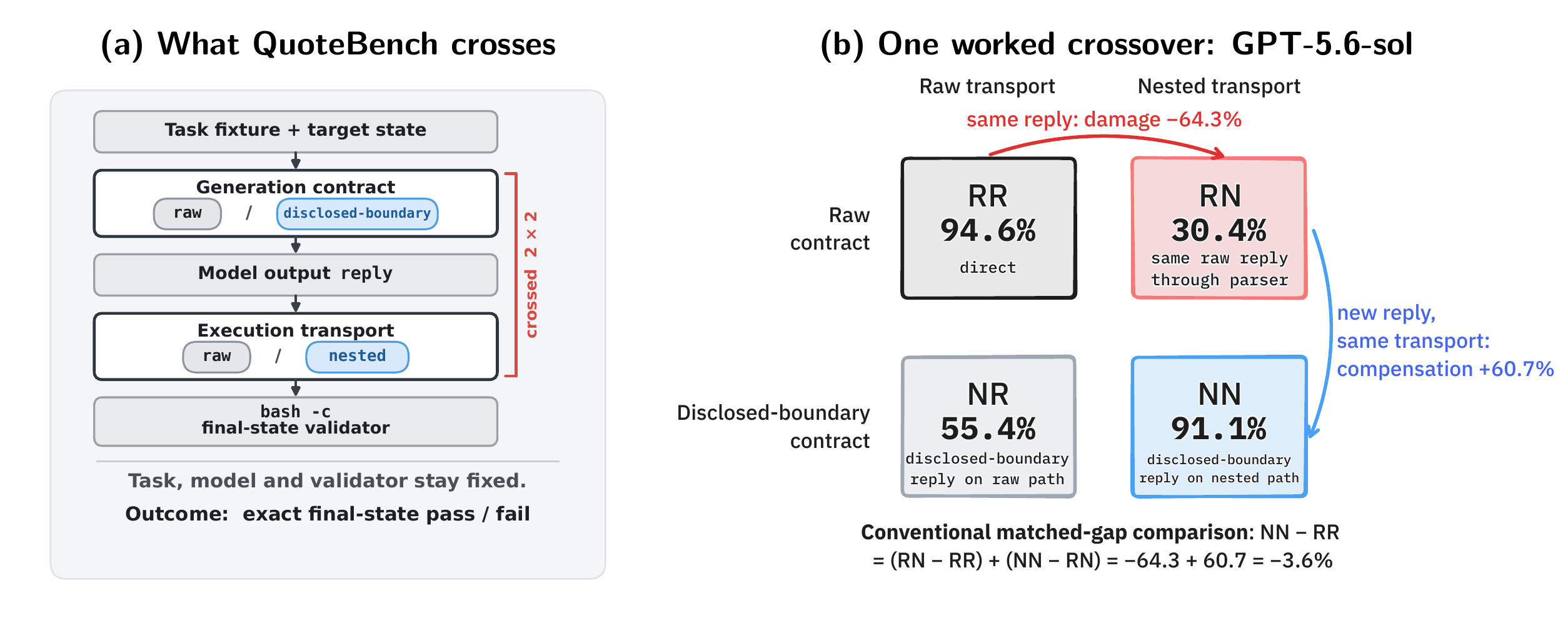
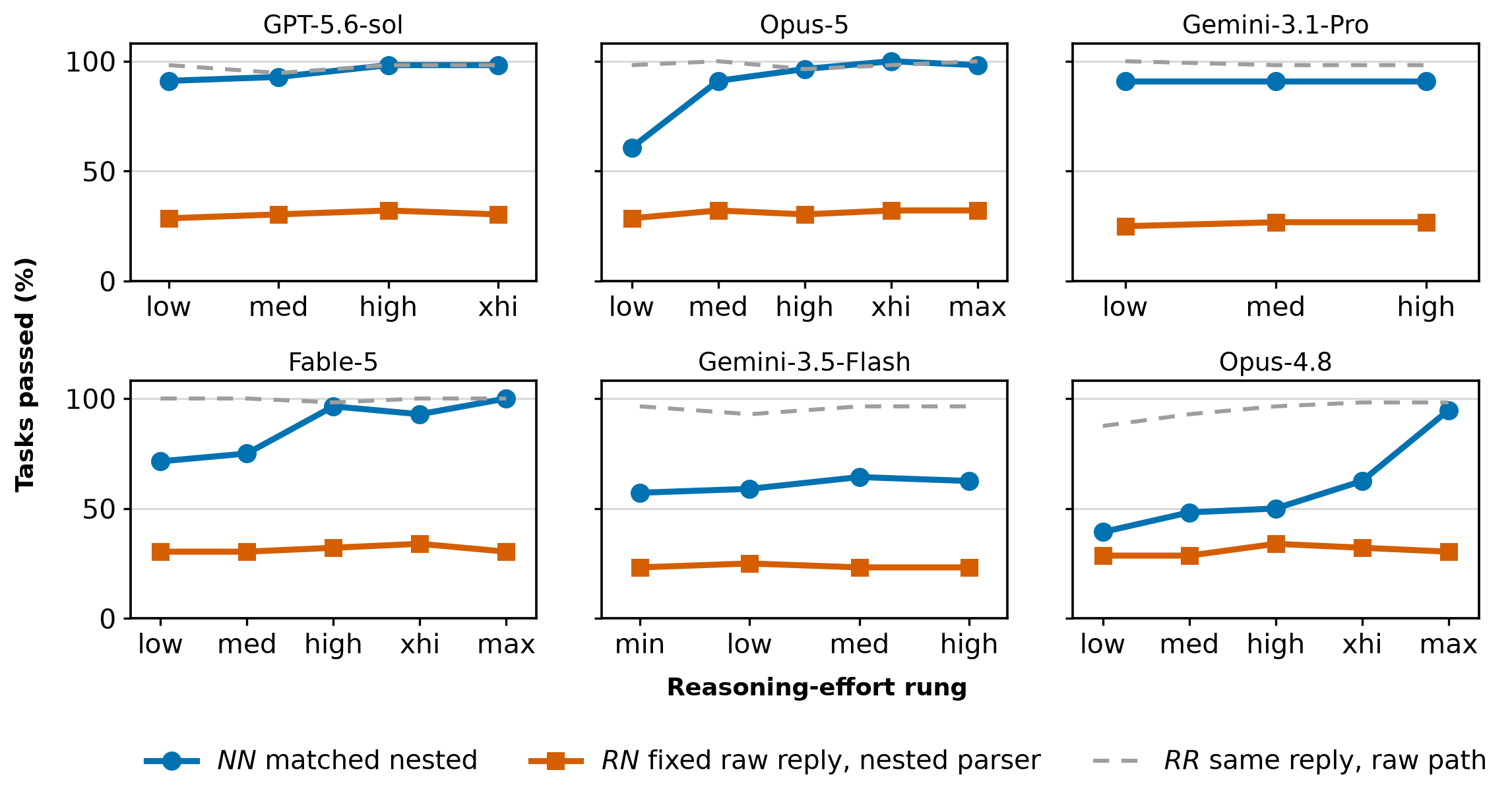
The same-window crossover is the controlled evidence. The scorecards below it are descriptive summaries of the released result files.
Study A — same-window crossover (controlled)
| model | RR | RN | NR | NN | damage | compensation | matched gap |
|---|
| GPT-5.6-sol | 94.6 | 30.4 | 55.4 | 91.1 | −64.3 | +60.7 | −3.6 |
| GPT-5.5 | 100.0 | 28.6 | 50.0 | 89.3 | −71.4 | +60.7 | −10.7 |
| Opus-5 | 96.4 | 30.4 | 42.9 | 89.3 | −66.1 | +58.9 | −7.1 |
| Gemini-3.1-Pro | 98.2 | 25.0 | 33.9 | 80.4 | −73.2 | +55.4 | −17.9 |
| Gemini-3.5-Flash | 96.4 | 28.6 | 67.9 | 58.9 | −67.9 | +30.4 | −37.5 |
| Opus-4.8 | 91.1 | 26.8 | 62.5 | 57.1 | −64.3 | +30.4 | −33.9 |
| Qwen3.5-27B | 85.7 | 30.4 | 83.9 | 30.4 | −55.4 | 0.0 | −55.4 |
| Gemini-3.1-Flash-Lite | 78.6 | 19.6 | 80.4 | 14.3 | −58.9 | −5.4 | −64.3 |
Trial 0, GNU replay, percentages of 56 tasks. RR/RN: raw reply on the raw/nested path; NR/NN: disclosed-boundary reply on the raw/nested path. Damage = RN − RR, compensation = NN − RN, matched gap = NN − RR.
Study A — best-observed scorecard (descriptive)
| model | best observed setting | control | hostile | all 56 | hostile LOFO |
|---|
| GPT-5.5 | xhigh | 14/14 | 42/42 | 100.0% | [100.0, 100.0] |
| Opus-5 | xhigh | 14/14 | 42/42 | 100.0% | [100.0, 100.0] |
| Fable-5 | max | 14/14 | 42/42 | 100.0% | [100.0, 100.0] |
| GPT-5.6-sol | high | 14/14 | 41/42 | 98.2% | [97.4, 100.0] |
| Opus-4.8 | max | 12/14 | 41/42 | 94.6% | [97.4, 100.0] |
| Gemini-3.1-Pro | low | 14/14 | 37/42 | 91.1% | [87.2, 89.7] |
| Sonnet-4.6 | high | 9/14 | 27/42 | 64.3% | [61.5, 69.2] |
| Gemini-3.5-Flash | medium | 10/14 | 26/42 | 64.3% | [59.0, 66.7] |
| Haiku-4.5 | medium | 8/14 | 13/42 | 37.5% | [28.2, 33.3] |
| Qwen3.5-27B | non-think | 8/14 | 9/42 | 30.4% | [15.4, 23.1] |
| Qwen3.5-4B | think | 5/14 | 7/42 | 21.4% | [10.3, 17.9] |
| Qwen3.5-9B | non-think | 5/14 | 5/42 | 17.9% | [5.1, 12.8] |
| Gemini-3.1-Flash-Lite | default | 6/14 | 2/42 | 14.3% | [2.6, 5.1] |
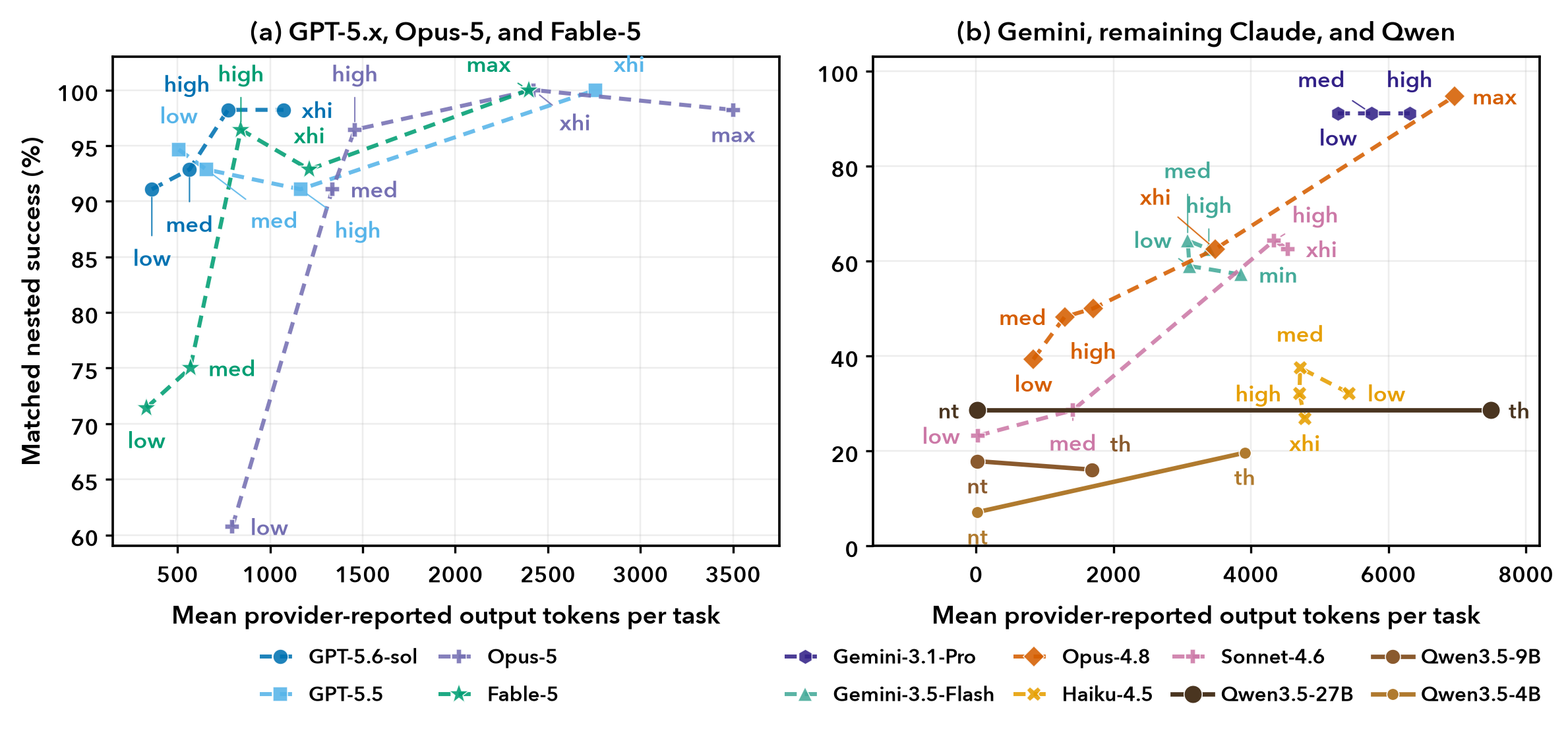
Trial-0 matched-nested final-state success on the same 56-task core in the pinned GNU/Linux replay. Updated 2026-08-05. Each base model contributes its highest-scoring measured setting; ties prefer default, then lower reported output tokens. This is a descriptive best-observed summary.
Study B — provider-native shell-tool campaign (observational)
| model configuration | paired task–rung trials | raw | native | Δ |
|---|
| Opus-4.8 | 840 | 95.4% | 98.0% | +2.6 |
| Opus-5 | 840 | 98.2% | 97.4% | -0.8 |
| Fable-5 | 840 | 99.3% | 97.1% | -2.1 |
| Gemini-3.1-Pro | 504 | 98.8% | 95.0% | -3.8 |
| GPT-5.6-sol | 672 | 96.9% | 94.3% | -2.5 |
| Gemini-3.5-Flash | 672 | 95.7% | 85.7% | -10.0 |
GNU replay, averaged over every measured effort rung and three trials per task/protocol cell. Updated 2026-08-05. This campaign measures a structured shell-tool boundary and is not numerically commensurable with the best-observed Study-A scorecard.